Paystand used the keynote stage at Bitcoin Las Vegas on Sunday to announce USDb, a USD-pegged stablecoin natively issued on Rootstock with secondary support on Blockstream's Liquid Network and Lightning. The launch is positioned in deliberately specific terms: USDb is built for B2B payment workflows — accounts receivable, accounts payable, payroll, treasury — rather than for crypto trading or retail transfers, the segments that account for roughly 90% of existing stablecoin flow.
The architectural choice and the positioning are tightly linked, and both deserve unpacking on their own terms.
The Bitcoin-Native Architecture
USDb is the first major USD-pegged stablecoin issued natively across Bitcoin's secondary layers rather than on Ethereum, Solana, or Tron — the chains that host roughly 99% of existing stablecoin float. The technical case has three components.
Rootstock, an EVM-compatible sidechain merge-mined with Bitcoin, hosts the smart-contract logic that programmable stablecoin issuance requires. Rootstock has existed since 2018 but has been niche; USDb is the largest stablecoin issuance ever directed to it.
Liquid, Blockstream's federated Bitcoin sidechain, provides a second venue with different settlement properties — confidential transactions, faster finality, and a different validator-set composition. Liquid has hosted L-USDt (a USDT variant) since 2019 but at small scale.
Lightning compatibility, while technically operating on top of Bitcoin's main chain rather than as a separate stablecoin venue, is mentioned as part of the multi-layer architecture for fast low-cost transfers.
Ibex was named as the first minting partner and liquidity provider — a meaningful detail because Ibex is one of the established institutional Bitcoin-infrastructure firms, and the minting-partner role is what determines whether USDb has the operational liquidity to be functional at the volumes Paystand is targeting.
The Distribution Argument
The strategic case for USDb is not the technical architecture — it is that Paystand has a working B2B payments distribution channel already.
The published numbers: Paystand's network has processed more than $20 billion in payment volume across more than one million businesses in North America and Latin America. The November 2025 acquisition of Bitwage added an API-first cross-border payouts capability covering roughly 200 countries, 90,000 individual recipients, and 4,500 companies.
That is, in the language Paystand prefers, an addressable customer base with which the stablecoin can be deployed without first needing to build a market. USDb's first commercial application is cross-border payments through Bitwage's existing rail. The migration thesis is that Paystand customers who currently process payment volume through traditional rails can migrate that volume to USDb-denominated settlement without changing software vendor.
CEO Jeremy Almond's framing is characteristically aggressive: "AI is eating labor. Bitcoin is eating capital. Stablecoins are eating financial services. USDb is where those three forces converge." More analytically useful was a separate quote from his keynote: "We think that most stablecoins have come out of the retail world. This is a stablecoin for business."
The second framing is a real strategic claim worth taking seriously.
The Niche Argument and Its Limits
The B2B-specific positioning has commercial logic. Stablecoin transaction volumes hit $33 trillion in 2025 (per Artemis Analytics, up 72% year-over-year), but the substantial majority of that flow is exchange-to-exchange settlement, retail transfers, and DeFi composability — not the AR/AP/payroll/treasury workflows that Paystand is targeting. The B2B segment is structurally underpenetrated, and a stablecoin designed specifically for those workflows could plausibly capture a meaningful share of the underpenetrated segment.
The limits of the argument are also real.
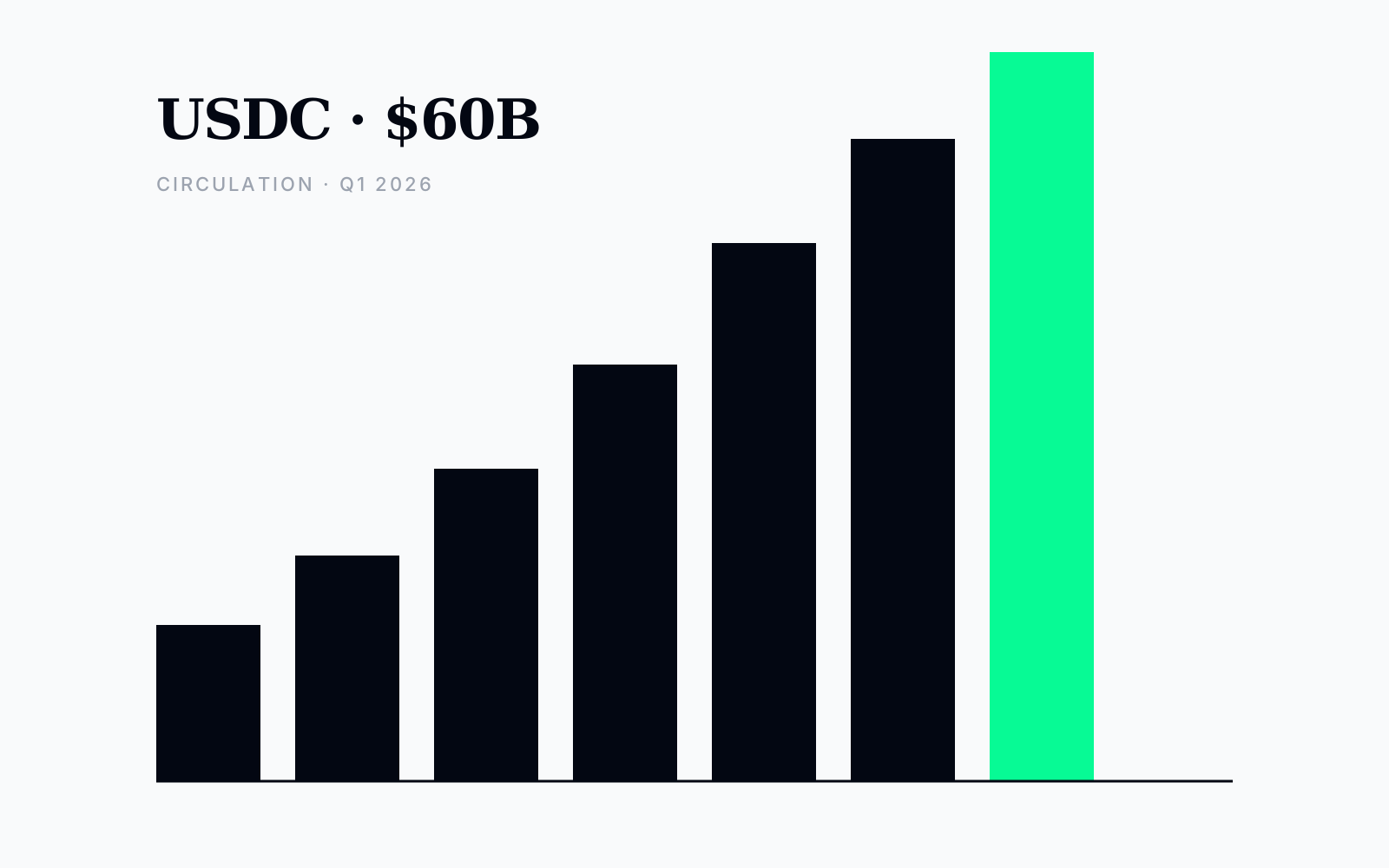
USDC's enterprise tier and Circle's broader institutional product set are not abstractly competitive — they are actively pursuing the same B2B workflows USDb is targeting, with a substantially larger existing customer footprint and deeper integrations across treasury-management software. PayPal's PYUSD has been moving aggressively into B2B with the recent merchant rollout. RLUSD is positioned for institutional settlement. Each of these has more existing scale than USDb starts with, and the specific differentiation USDb offers — Bitcoin-native architecture and Paystand-network distribution — is meaningful but not by itself decisive.
Tony DeSanctis at Cornerstone Advisors made the moderate version of the skeptical case in commentary to American Banker: stablecoins' primary use case continues to be cross-border and remittance, with smart-contract-native workflows likely to be a 18-to-36-month evolution rather than an immediate adoption story. That framing maps closely to what Paystand can credibly claim for USDb's first year — meaningful Bitwage cross-border settlement volume, modest enterprise pilots beyond that — without yet validating the broader thesis.
The Regulatory and Reserve Question
The launch announcement was thin on the details that matter most for institutional adoption.
On regulation, Paystand says it expects to launch in a "GENIUS-aligned manner" and achieve full U.S. compliance by end of 2026, with GM Meredith Petty noting that the company already holds international digital-asset and wallet operating licenses in relevant jurisdictions. The GENIUS Act framing places USDb in the same regulatory bucket as the broader U.S. stablecoin legislation pathway, but the act itself has not yet produced operational rule-making, so what "GENIUS-aligned" means in practice is partially aspirational.
On reserves, the disclosure to date is that USDb is backed 1:1 by USD reserves. The custody arrangement, auditor identity, attestation cadence, and reserve composition specifics have not been published. For a stablecoin targeting institutional B2B usage — the segment where reserve transparency matters most — these are not optional disclosures over time. The launch announcement is silent on them; the next quarter will be informative on whether the operational reserve infrastructure matches the institutional positioning.
What's Worth Watching
Three signals will indicate whether USDb scales toward the strategic ambition or stays a niche product.
Bitwage migration volume. Paystand has a clean, measurable migration path: the existing Bitwage cross-border payment volume is the most natural use case for USDb, and the share of that volume that converts to USDb settlement within Q3 will be the most concrete signal of product-market fit. A meaningful migration share would validate the underlying thesis. A slow migration would suggest that even Paystand's own customer base prefers existing stablecoin alternatives or fiat rails.
Reserve disclosure cadence. Whether Paystand publishes a substantive reserve attestation within the first quarter, and whether the custody and auditor arrangements look comparable to what USDC and PYUSD provide, will determine whether institutional treasurers can credibly evaluate USDb as an alternative to incumbent stablecoins.
Bitcoin-infrastructure ecosystem response. USDb's case for the Bitcoin-aligned architecture depends on the broader Bitcoin-infrastructure ecosystem (wallet providers, custodians, exchanges, payment processors) integrating it. If the integrations follow within six months, the architectural choice produces real network effects. If they don't, USDb risks being a stablecoin issued on chains that the rest of the stablecoin market doesn't natively support.
For Paystand, the launch is a coordinated bet that B2B-specific stablecoin design and Bitcoin-native infrastructure together produce a defensible market position. For the broader stablecoin landscape, USDb is the first significant test of whether Bitcoin's secondary layers can host stablecoin issuance at meaningful scale — a question the industry has been deferring for years. The next twelve months will produce the answer in volume data, reserve disclosures, and competitive response that the launch press release alone cannot.
Sources:
- Paystand Launches USDb: The First Bitcoin-Aligned Stablecoin Purpose-Built for the $100 Trillion B2B Economy — BusinessWire
- Paystand Launches USDb Stablecoin On Bitcoin Layers For $100T B2B Payments — Bitcoin Magazine
- Paystand plans to launch its own B2B stablecoin — American Banker
- First Bitwage, Now USDb: Paystand's Stablecoin Backbone for B2B Cash Flow — Trade Credit Substack
- New USDb Stablecoin Brings Bitcoin Payments to Enterprises — CoinLaw